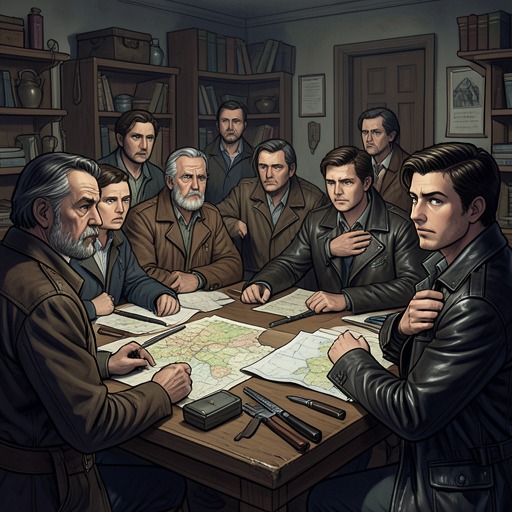
Uncas’s Delaware war mobilization
The Last of the MohicansUncas’s Delaware war mobilization is the collective decision to pursue Magua after he takes Cora away. It transforms the Delawares’ anger into an expedition: Uncas publicly claims leadership, the warriors commit themselves to war, and a force of more than two hundred enters the forest under his command.
Causes and Immediate Context
After Magua departed with Cora, Uncas watched her until she vanished among the trees, then withdrew from the gathered Delawares. Their camp became restless as the people awaited his lead. The pursuit also followed a period of political and rhetorical maneuvering: Magua had used the Hurons’ grief for their dead to demand revenge, and later appealed to the Delawares with gifts, praise, and reminders of their exposed position between French and English power. The mobilization marks the point at which the Delawares’ response becomes action rather than debate.
The War Rite and Uncas’s Leadership
The preparations proceeded through public signs. A young warrior stripped bark from a small pine; others removed its branches and marked its trunk with red paint. Uncas appeared with most of his clothing removed and his face partly painted black, then circled the post in a measured dance while singing a war song that invoked the Great Spirit, acknowledged his own weakness, and asked for aid. The repeated song and dance gave the gathering a shared form for expressing resolve.
A respected Delaware chief joined the dance, followed by other warriors. Uncas then struck his tomahawk into the post and raised his battle cry. That act announced his authority over the expedition. A hundred young men surged forward and destroyed the symbolic target, and the narrator presents their participation as making the undertaking a war of the whole nation. The rite had converted individual anger into a public commitment.
From Commitment to Expedition
Uncas signaled that the truce with Magua had reached its end, and the warriors turned from symbolic action to preparations for the actual pursuit. Women carried children, elders, and valued possessions into the forest for safety; Tamenund also withdrew after a moving parting with Uncas. Duncan Heyward took Alice to safety before seeking out Hawkeye.
Uncas organized the force and appointed commanders. He presented Hawkeye as a proven and trustworthy warrior, then gave him twenty men to command. He explained Heyward’s standing among the English troops and offered him an equivalent responsibility, but Heyward declined, choosing instead to serve as a volunteer beside Hawkeye. More than two hundred Delaware warriors obeyed Uncas’s order to march.
The March and Its Stakes
The force entered the forest without encountering anyone who could provide warning or intelligence, then halted at the scouts’ positions for a private council. The chiefs proposed plans, but none suited Uncas’s desire for an immediate attack. Remembering Cora’s danger and Magua’s insolence, he had to restrain his own urgency and accept deliberation in keeping with his people’s practice. The mobilization therefore establishes both his authority and its limits: he leads the expedition, but must work through counsel and collective custom.